Stewreads: an MCP Connector That Turns Claude Chats into Kindle Ebooks
I learn a lot from Claude. Probably more than I'd like to admit. But that knowledge has a way of disappearing. A 30-minute learning session in a chat window feels no different from scrolling through a StackOverflow thread. The insight is technically in there somewhere, but good luck finding it again. The chat format just wasn't built for retention or re-reference.
I wanted to fix that. So I built StewReads, an MCP connector that transforms Claude conversations into formatted ebooks and delivers them straight to your Kindle or email.
The Problem
Chat interfaces are built for back-and-forth. They're great for brainstorming, debugging, exploring ideas. But they're terrible for revisiting what you learned. You scroll, you skim, you lose context between the questions and the answers. The valuable stuff gets buried in the conversational noise.
I kept having these really productive sessions with Claude, deep dives into topics I didn't know much about, and then they'd just... evaporate. I'd close the tab and move on. Maybe I'd remember the gist, but the nuance was gone.
The Insight
Two things clicked for me.
First, while not every individual Claude response is gold, a solid 20-30 minute chat on a topic accumulates a lot of knowledge worth preserving. The conversation as a whole is greater than the sum of its parts. Context matters, who knew.
Second, ebooks sent to a Kindle email address show up on every device with the Kindle app. Not just Kindle hardware. Your phone, your tablet, your laptop. That means you don't need a Kindle device. Anyone with a smartphone and the free Kindle app can read these. That's a lot of people.
That realization changed how I thought about the whole project.
What I Built
StewReads is an MCP (Model Context Protocol) connector. If you're not familiar with MCP, it's Anthropic's open standard for connecting AI models to external tools and data.
Here's how it works in practice: you have a great learning session with Claude. When you feel like the conversation is worth preserving, you tell Claude to use StewReads. Claude condenses the conversation into a nicely formatted ebook, and then StewReads converts it to EPUB and emails it to your Kindle or any email address. The book shows up on your device in 2-3 minutes.
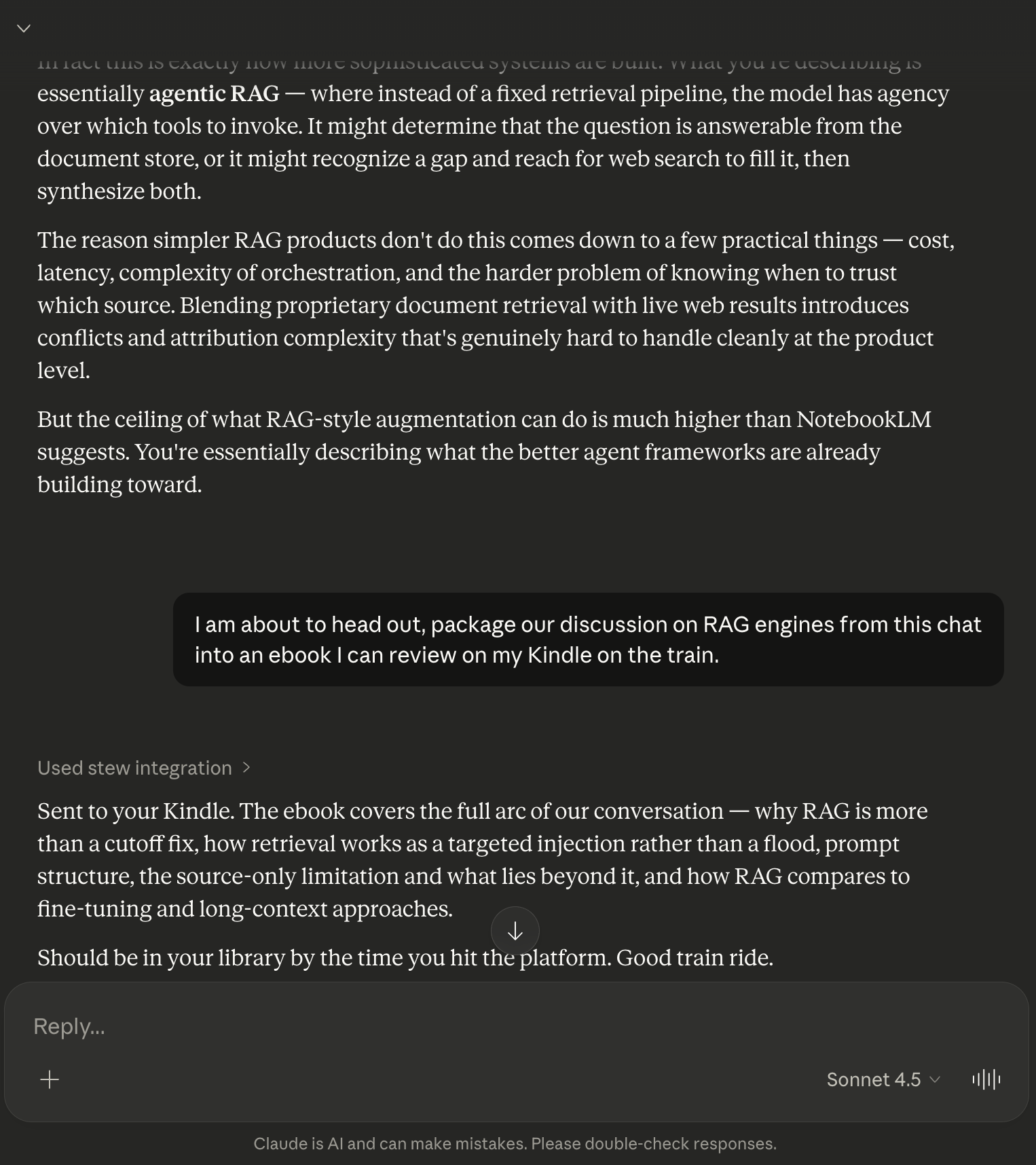
You can invoke it naturally ("turn this conversation into an ebook and send it to my Kindle") or use the /stew prompt shortcut.
The core pipeline:
The MCP server exposes tools that Claude calls directly when you invoke StewReads, passing the conversation context and your delivery preferences. StewReads supports OAuth2 for secure authentication.
Learning MCP
I went into this knowing almost nothing about MCP. What I found most fascinating was how much control you get over model behavior through the MCP primitives.
Tool descriptions, for instance, aren't just documentation. They're instructions that influence when and how Claude decides to use your tools. The way you describe a tool changes Claude's behavior around it. Write a vague description and Claude will call your tool at odd times or not at all. Write a precise one and Claude knows exactly when to reach for it. It's prompt engineering, but for tool selection.
Then there are MCP prompts. These let you inject system-level instructions into Claude's context when invoked. For StewReads, this is where the magic happens. The /stew prompt doesn't just say "make an ebook." It carries detailed formatting instructions, ebook structure guidelines, paragraph length constraints, all the things that make the output actually read well on an e-reader. Claude follows these instructions as if they were part of the conversation.
This was the real unlock for me. MCP isn't just plumbing to connect Claude to external APIs. It's a way to shape how Claude thinks and responds for a specific use case. The tools handle the doing, the prompts handle the thinking, and together they let you build something that feels purpose-built rather than bolted on.
The Slow Cooking Philosophy
I called it StewReads because the metaphor felt right. Chat with Claude is fast, reactive, exploratory. System 1 thinking. But real learning needs time to simmer. You need to revisit ideas, let them settle, make connections you missed the first time around.
If you've read Daniel Kahneman's Thinking, Fast and Slow, you know the distinction. System 1 is intuitive and quick. System 2 is deliberate and effortful. A Claude chat is pure System 1. StewReads is the System 2 companion. It takes the raw ingredients from a fast-paced conversation and slow-cooks them into something you can digest at your own pace.
Here's StewReads in action:
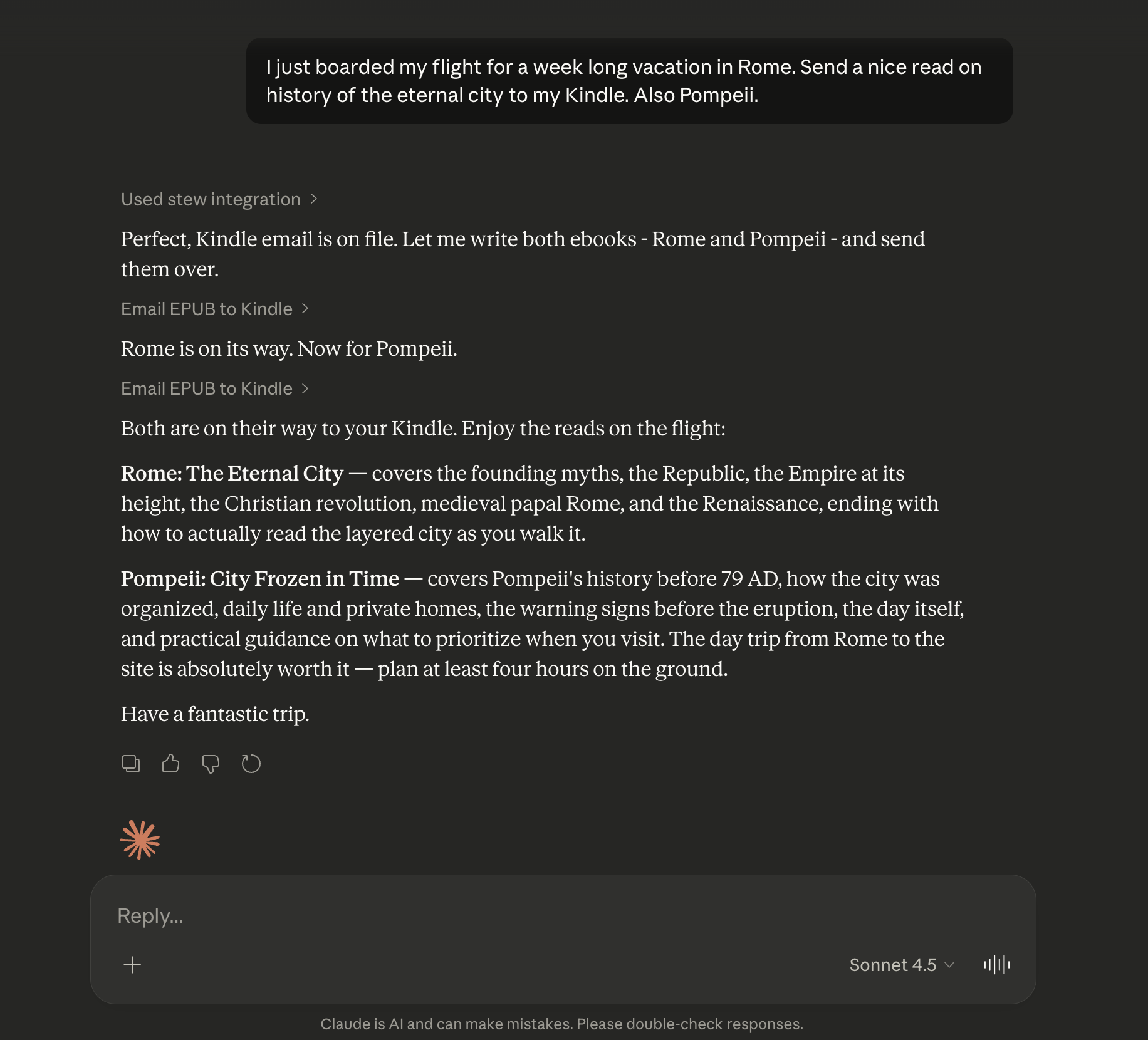
Two ebooks delivered to kindle with one prompt in minutes. You can switch tabs, apps or close your device, Claude will finish your request.
Here are some real ways I use it:
I just boarded my flight for a week long vacation in Rome. Send a nice read on history of the eternal city to my Kindle. Also Pompeii.
Rome: The Eternal City
Pompeii: City Frozen in Time
I am about to start my commute, package our discussion on RAG engines from this chat into an ebook I can review on my Kindle on the train.
Understanding RAG Engines
I read The Count of Monte Cristo a long time ago, it had a deep impact on me. I want to revisit it but it's very long. The book is in public domain now, can you generate an ebook on the crazy journey Dantes goes through? Explore it from a philosophical perspective.
The Count of Monte Cristo
My mental model: not every conversation deserves an ebook, just the ones that genuinely taught you something. Creating an ebook is the highest praise for a chat.
Where It Stands
StewReads is live as an MCP connector. I've submitted it to Anthropic's first-party connectors directory.
I've been using it daily. The workflow has become second nature: have a learning session, invoke StewReads, continue reading on my Kindle app during my commute. Each ebook becomes a volume in a growing personal library of things I've learned through Claude.
What's Next
I'm exploring audiobook generation using ElevenLabs as an additional output format. The idea of turning a Claude conversation into something you can listen to on a run is compelling.
Longer term, I'm thinking about evolving StewReads into a standalone app. A personal library for all these AI-generated artifacts. Ebooks, audiobooks, study guides. A place where your best conversations don't just disappear.
Try It
If you want to try StewReads, the setup guide is at stewreads.com/help/mcp.
A few things to know: it uses your Claude tokens, so be mindful. Ebook size is capped at 2000 words as a guardrail. I use sonnet for brainstorming and learning, and can comfortably generate an ebook a day on the Pro plan.
Happy Stewing!